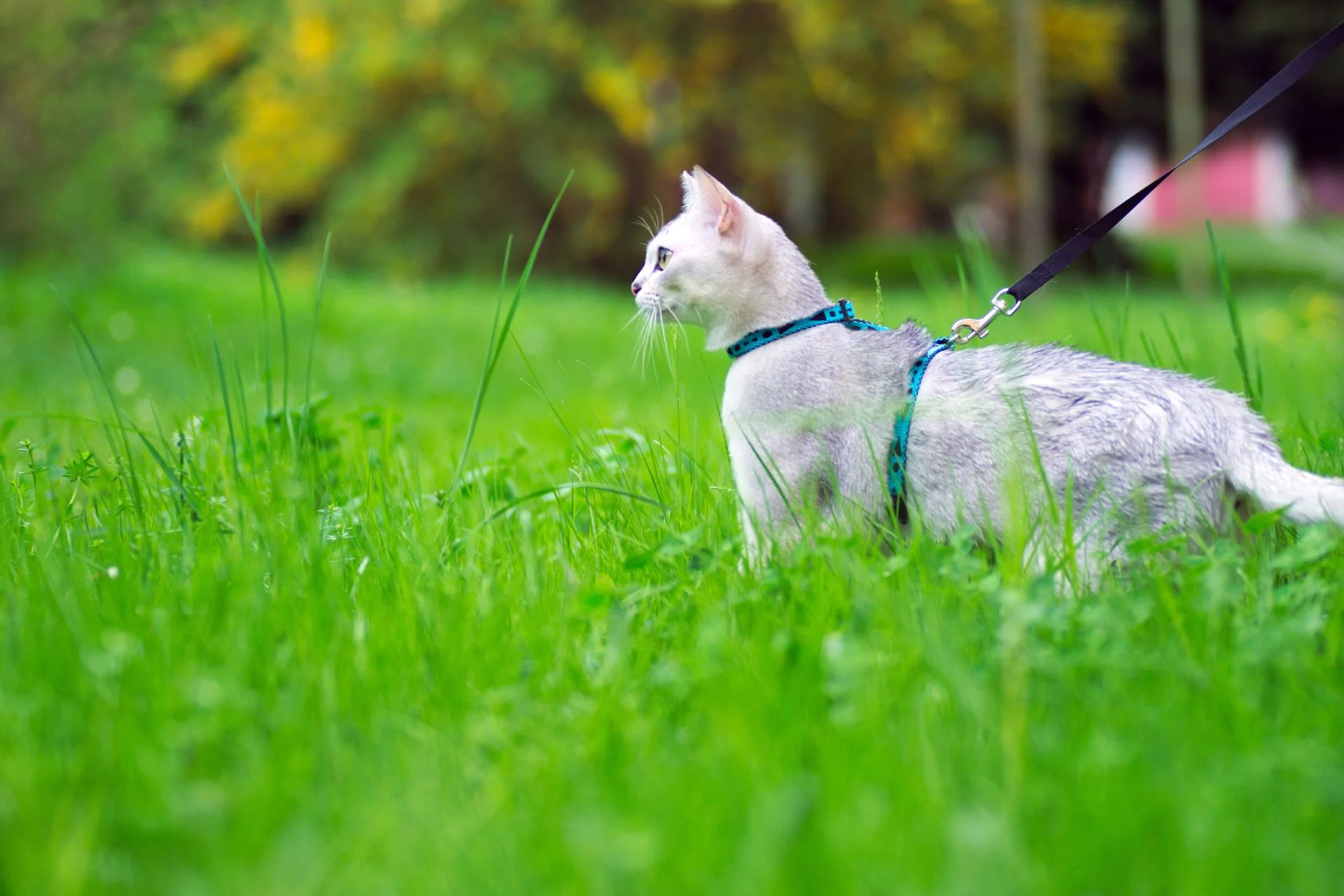
Cat leash training is not about teaching your cat to heel. It is about giving them controlled access to outdoor enrichment without the risks of unsupervised outdoor access, and making it possible for a cat sitter or pet sitter to provide that enrichment safely while you're away. Leash-trained cats have more options for exercise and stimulation regardless of who is caring for them.
The process takes patience. Some cats adapt in two to three weeks; others need two to three months. What determines the timeline is temperament and how consistently you work through each stage before moving to the next.
Why leash train your cat
Indoor cats need physical activity and mental stimulation that can be hard to provide entirely within four walls. Leash walks offer both: new scents, sights, and terrain engage a cat's senses in ways that indoor toys cannot fully replicate. For cats with excess energy or boredom-related behaviors, regular supervised outdoor time makes a meaningful difference.
There is a practical benefit when it comes to cat sitting. A cat sitter working with a leash-trained cat has more options for exercise and enrichment during your absence (controlled outdoor time in your garden, a supervised exploration of a quiet outdoor space) rather than being limited to indoor play. Cat sitters also appreciate knowing exactly what the routine involves, which harness fits your cat, and how your cat signals stress. That information makes the sitting arrangement safer and more consistent with what your cat is used to.
Choosing the right harness and leash
Never attach a leash to a collar. Cats can slip a collar under pressure, and a sudden pull on a collar can cause neck injury. A properly fitted harness distributes pressure across the chest and shoulders: safe even if your cat pulls or startles.
Two harness styles work well for cats: H-style harnesses, which use two loops connected by a horizontal strap, and vest-style harnesses, which wrap around the torso and are harder to escape from. For cats who are escape-prone or particularly wriggly, a vest harness is more secure. Whichever style you choose, you should be able to fit two fingers between the harness and your cat's body: snug enough to prevent escape, loose enough for comfort.
Choose a lightweight leash, around 1.5 to 2 metres (5 to 6 feet), with a small, light clasp. A heavy leash or large metal clip will be distracting or uncomfortable for a cat who is not yet used to having anything attached to their body.
Step-by-step cat leash training
Step 1: Introduce the harness before putting it on
Place the harness in an area your cat regularly rests or passes through (not in their face, just nearby) for two to three days before you attempt to put it on. Cats investigate new objects on their own terms; giving them time to sniff and assess the harness before it touches them removes a significant source of initial resistance.
When you first put it on, keep it on for sixty seconds and offer high-value treats throughout. Remove it before your cat shows any sign of stress. Repeat this several times a day, adding thirty seconds each session. The goal at this stage is not wearing time: it is building the association that harness on equals good things happening.
Step 2: Build harness wearing time indoors
Once your cat accepts being harnessed without resistance, gradually extend wearing sessions to five, then ten, then fifteen minutes over the course of a week or two. Check that your cat can walk, eat, groom, and play normally while wearing it. A cat who freezes completely the moment the harness goes on needs more time at the shorter-duration stage before progressing.
Step 3: Attach the leash and let it drag
Clip the leash to the harness while indoors and let your cat drag it around under your supervision. Don't hold it yet, just let your cat get used to the weight and the sensation of something following them. Watch to make sure the leash doesn't catch on furniture. Reward calm behavior with treats throughout. This stage typically takes three to five days.
Step 4: Practice indoor walking
Pick up the leash and follow your cat rather than leading them. Keep the leash slack: the goal is to hold it, not to guide through it. If you want to encourage your cat to move in a direction, use a treat or toy in front of them rather than leash pressure. Never jerk, pull, or drag. Sessions of five to ten minutes, twice a day, build the association between the leash and positive outcomes without overwhelming a cautious cat.
Step 5: First outdoor sessions
When your cat walks confidently indoors on leash, they're ready for outside. Carry them out rather than letting them walk through the door: a cat who learns they can bolt out the door off-leash when they feel like it is harder to manage. Start in a quiet, enclosed space: a garden, a balcony, a low-traffic side street. Keep the first session to five minutes maximum.
Many cats freeze or crouch when they first go outside, even if they were confident indoors. This is normal: the sensory difference between inside and outside is significant. Sit with them, let them observe, and don't push forward movement. The outdoor environment will feel less overwhelming after several short sessions than if you try to get a full walk on the first outing.
Ensure vaccinations and flea and tick prevention are current before any outdoor sessions begin.
Reading your cat's stress signals
Flattened ears, a heavily lashing tail, crouching with the body low to the ground, growling, or attempts to escape the harness all mean the session has gone further than your cat is comfortable with. Stop the session, return indoors, remove the harness calmly, and try again another day starting at a less demanding stage. Pushing through stress signals creates fear associations that are hard to undo.
A cat sitting calmly, sniffing their surroundings, and moving at a relaxed pace is a cat having a positive experience. Progress is measured by how consistently you see that behavior, not by how far you walk.
What to tell your cat sitter about leash walking
If you use a cat sitter while traveling, your cat's leash training is only useful if the sitter has the information to continue it safely. Before you leave, tell them: which harness your cat uses and how it fits, your cat's outdoor routine (how long, where, what time of day), the specific stress signals your cat shows when they've had enough, and what to do if your cat freezes or resists during a session.
A cat sitter who takes over a leash routine they don't fully understand may inadvertently undo weeks of training by pushing too hard or using the wrong gear. Written instructions matter more here than for most other care tasks. On Petme, you can find cat sitters experienced with leash-trained cats and communicate your cat's specific routine directly through the platform before confirming a booking.
Ready to find trusted cat sitters in your area? Download Petme for iOS and Android.
Frequently asked questions
1. Is it okay to leash train a cat?
Yes: leash training is safe and beneficial when done correctly. The key requirements are using a properly fitted harness rather than a collar, following the cat's pace rather than pulling, and building up to outdoor sessions gradually from an indoor foundation. Most cats can learn to tolerate or genuinely enjoy leash walks. Some cats are more naturally suited to it than others, but the training process itself does not harm cats who are introduced to it patiently.
2. How long does it take to leash train a cat?
The range is wide: confident, curious cats may reach comfortable outdoor walks within two to three weeks; more cautious or anxious cats typically need two to three months of gradual progression. Adult cats generally take longer than kittens. The factor that extends the timeline most reliably is rushing stages: moving to leash attachment before the harness is fully accepted, or taking a cat outside before indoor walking is solid. Each stage should be genuinely complete before you move to the next.
3. What is the 3-3-3 rule for cats?
The 3-3-3 rule describes the adjustment timeline for a cat in a new or changed environment: three days to stop hiding and begin observing, three weeks to settle into the household routine, three months to feel fully at home. It applies most directly to newly adopted cats but is relevant to any significant change, including a new cat sitter, a new outdoor environment, or the introduction of a harness. It is a useful reminder that behavioral adjustment takes time and that patience through the early stages produces better long-term outcomes than trying to accelerate the process.
4. What if my cat refuses to wear the harness?
Go back to the beginning and slow down. If your cat resists harness placement, spend more time at the familiarization stage (leaving it in their space, rewarding any voluntary interaction with it) before attempting to put it on. When you do put it on, keep wearing time extremely short (thirty seconds) and make it highly rewarding. Some cats need several weeks just to accept the harness before any leash work begins. If resistance persists despite a slow, consistent approach, consult your vet or a certified cat behaviorist.
5. Can I walk my cat off-leash outdoors?
No. Even well-trained cats can bolt unpredictably when startled, by a dog, a sudden noise, a bird. A cat who runs off in an unfamiliar or semi-familiar area can travel a significant distance very quickly. The leash and harness are not optional safety equipment that a sufficiently trained cat can graduate past; they are the thing that makes outdoor access safe in the first place.
6. Should I tell my cat sitter about my cat's leash training?
Yes, and in detail. Tell them which harness your cat uses, how it fits correctly, the length and route of your usual walks, how your cat typically behaves during sessions, and the specific signs that mean a session should end. A cat sitter covering a leash routine without this information may use the wrong harness, misjudge your cat's stress level, or try to push a session further than is comfortable. Clear written instructions are the most practical way to ensure consistency. 🐈
Leash training a cat takes longer than most people expect and produces results that are more varied than with dogs. What it reliably produces in cats who respond well is a form of controlled outdoor enrichment that would otherwise be unavailable to them, and a care routine that a cat sitter can continue safely in your absence. That combination makes the investment of time worthwhile.