No ancient culture left a more distinct record of its relationship with cats than Egypt. They appear in temple art, in grave goods, in legal texts, and in the accounts of Greek historians who found the Egyptian attitude toward cats bewildering. That record spans more than three thousand years and tells a story that is more complex, and more interesting, than the shorthand version of "Egyptians worshipped cats."
How cats arrived in ancient Egypt
The domestic cat (Felis silvestris catus) is descended from the African Wildcat (Felis silvestris lybica), which was native to North Africa and the Near East. Domestication appears to have happened multiple times in multiple places, but the oldest physical evidence of a cat buried deliberately with a human comes from a 9,500-year-old grave in Cyprus: predating Egyptian cat culture by several thousand years and suggesting that the human-cat relationship had already been developing for some time before it reached Egypt.
In Egypt, cats appear clearly in art and religious scenes from around 1980 BC, during the Middle Kingdom. The practical origin of their elevated status is visible in the historical record: Egypt's grain economy was one of the most sophisticated in the ancient world, and rodents were a significant threat to stored grain. Cats that killed rats and snakes around grain stores were genuinely valuable. The reverence that developed around them built on top of this practical foundation.
Bastet and the theology of cats
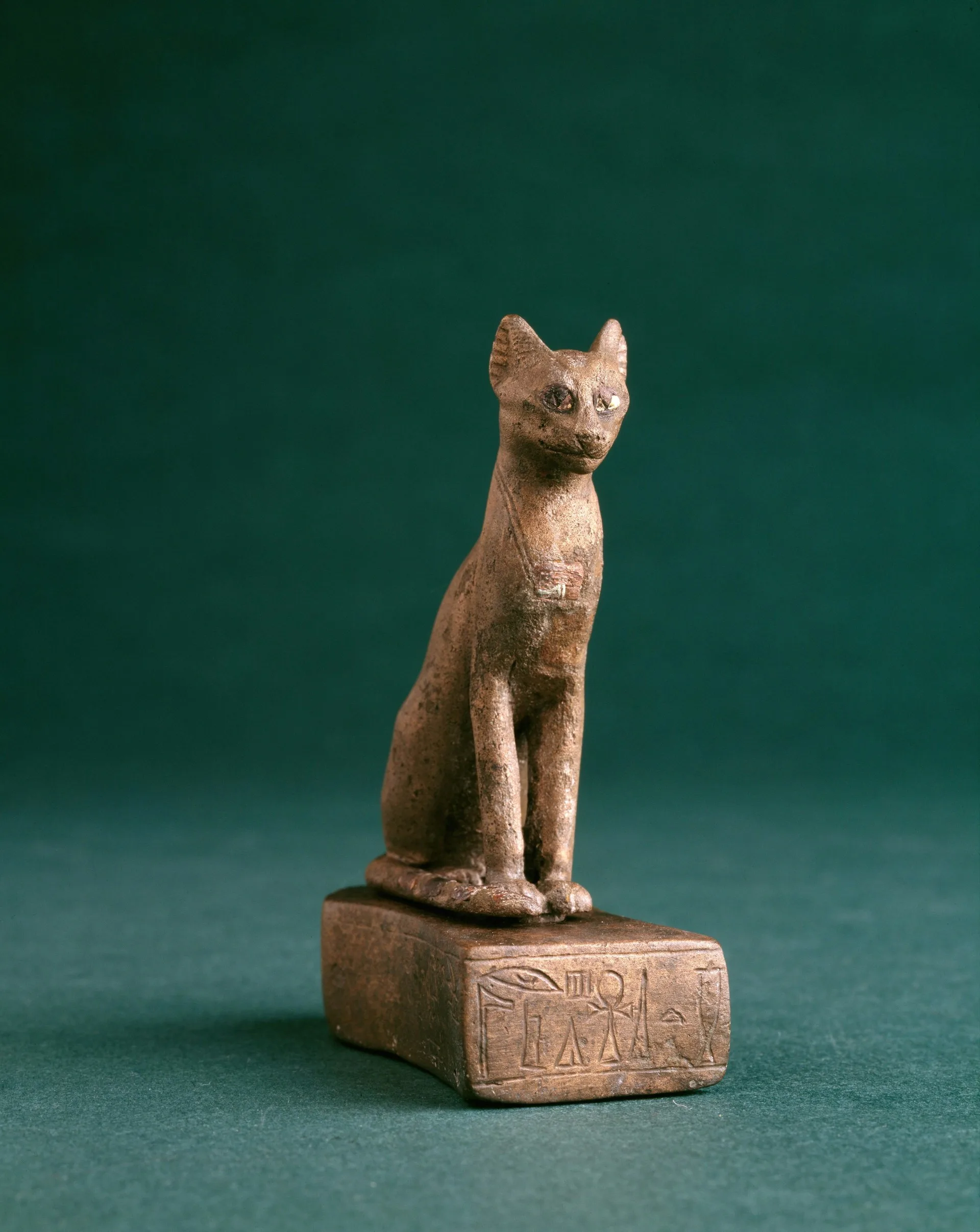
The goddess Bastet is the most recognized symbol of Egypt's relationship with cats, though her representation evolved significantly over time. In early periods, Bastet was depicted as a lioness, a fierce solar deity associated with protection and warfare. By the New Kingdom (1550–1070 BC), as the domestic cat became more culturally significant, she was increasingly portrayed as a domestic cat or as a woman with a cat's head, and her associations shifted toward fertility, motherhood, and household protection.
Her primary cult center was the city of Bubastis in the Nile Delta. The Greek historian Herodotus, writing in the 5th century BC, described the annual festival at Bubastis as drawing as many as 700,000 pilgrims who traveled by boat, singing and making noise as they went. The festival involved drinking, music, and celebration on a scale he described as the most widely attended in all of Egypt.
Cats in Egyptian art and cosmic mythology
Egyptian cats appear in one of the most significant scenes in the Book of the Dead: a spotted cat beneath a persea tree, severing the head of Apophis, the serpent of chaos that threatened Ra's solar barque during its nightly journey. This image recurs in tomb paintings and religious papyri and establishes the cat not merely as a household protector but as an agent of cosmic order. The cat defeats chaos so that the sun can rise.
In domestic tomb art, cats appear beneath chairs, a placement that signals they belong to the household. They are shown hunting birds in the marshes alongside their owners, or simply sitting in a state of watchful calm. The visual record is consistent across centuries: cats are present, valued, and integrated into both the sacred and the everyday.
The legal protection of cats and famous incidents
Killing a cat in ancient Egypt, accidentally or not, was a capital offense during the height of the New Kingdom. This was not merely a legal formality. The Greek historian Diodorus Siculus, writing in the 1st century BC, recorded a specific incident in which a Roman soldier accidentally killed a cat in Egypt and was lynched by a mob despite official attempts to protect him. The political complications of the incident (Egypt was a Roman client state at the time) did not spare him.
The most dramatic story involving Egyptian cat reverence is the Battle of Pelusium in 525 BC, in which the Persian king Cambyses II is said to have exploited Egyptian devotion by ordering his soldiers to carry cats in front of their advancing lines. Egyptian soldiers, unwilling to risk harming the animals, were reported to have surrendered rather than fight. The historical accuracy of this account is debated by scholars, but its persistence in ancient sources suggests it captured something real about how seriously the Egyptians took feline lives.
Mummified cats and the archaeology of veneration
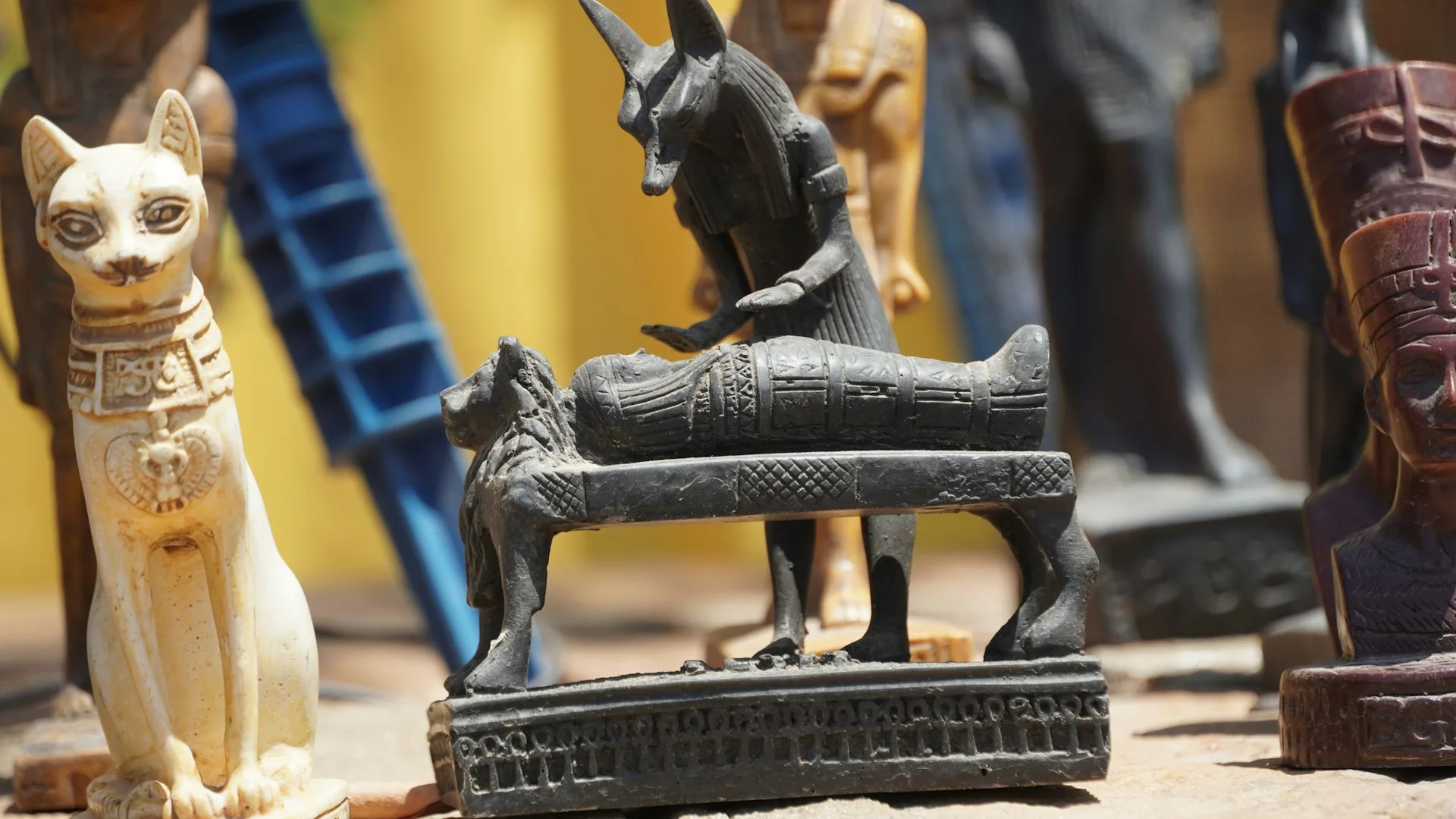
Cat mummification in ancient Egypt was widespread. Some mummified cats were beloved pets buried with their owners. Others appear to have been produced in large numbers as votive offerings at temples: deposited as acts of prayer or devotion, much as a person might light a candle in a church today.
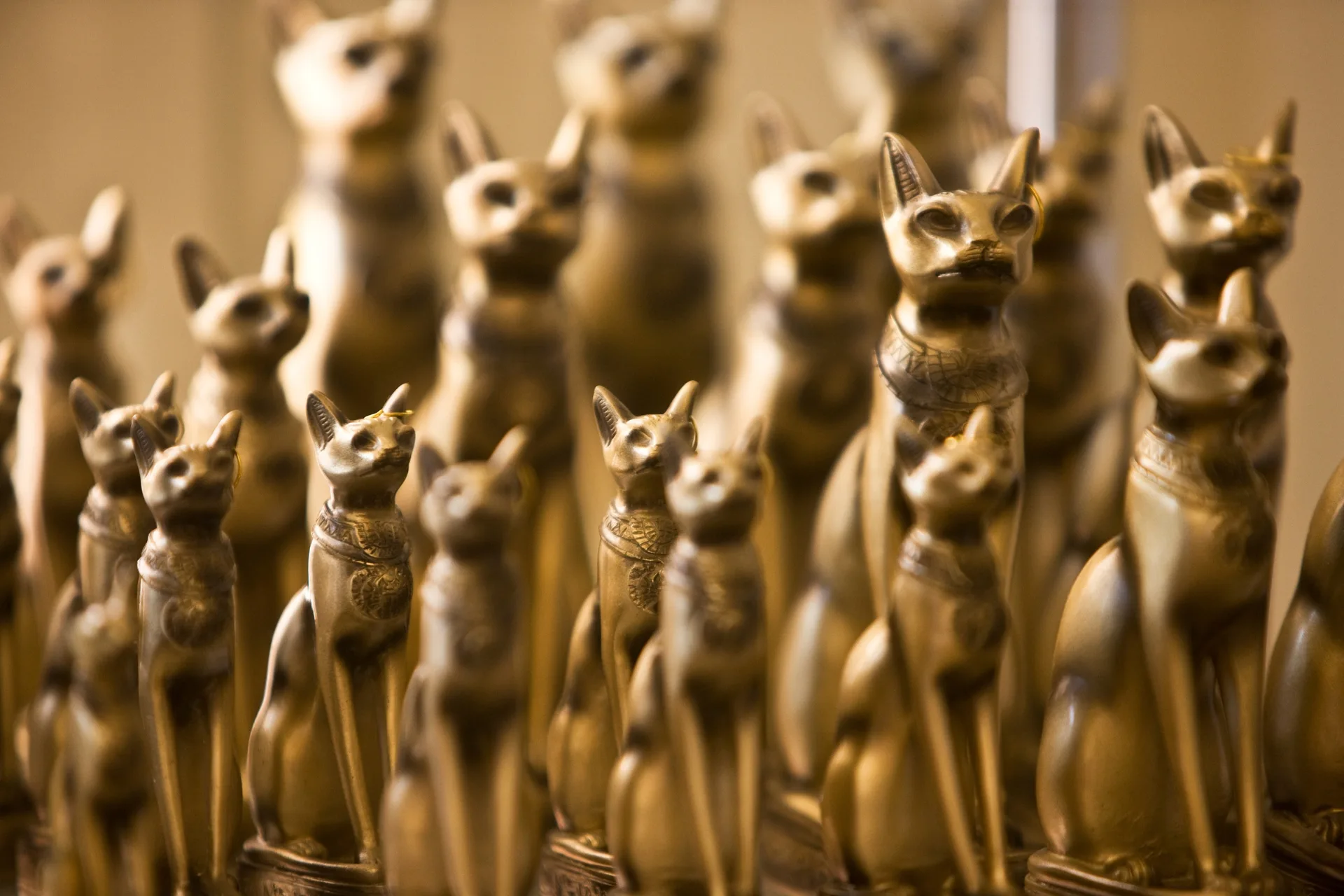
In 2018, excavations at Saqqara uncovered a cat necropolis containing over 100 gilded cat statues and numerous cat mummies alongside scarabs and other artifacts. Earlier excavations at Bubastis found large pits containing hundreds of thousands of feline remains. The scale of these deposits reflects organized religious production rather than individual pet burial.
The Egyptian response to a pet cat's death, per Herodotus, was to shave the eyebrows as a sign of mourning. When a dog died, the entire head and body were shaved. These customs provide a direct window into how genuinely attached Egyptians were to their animals as individuals, not merely as symbols.
Modern breeds: the living legacy
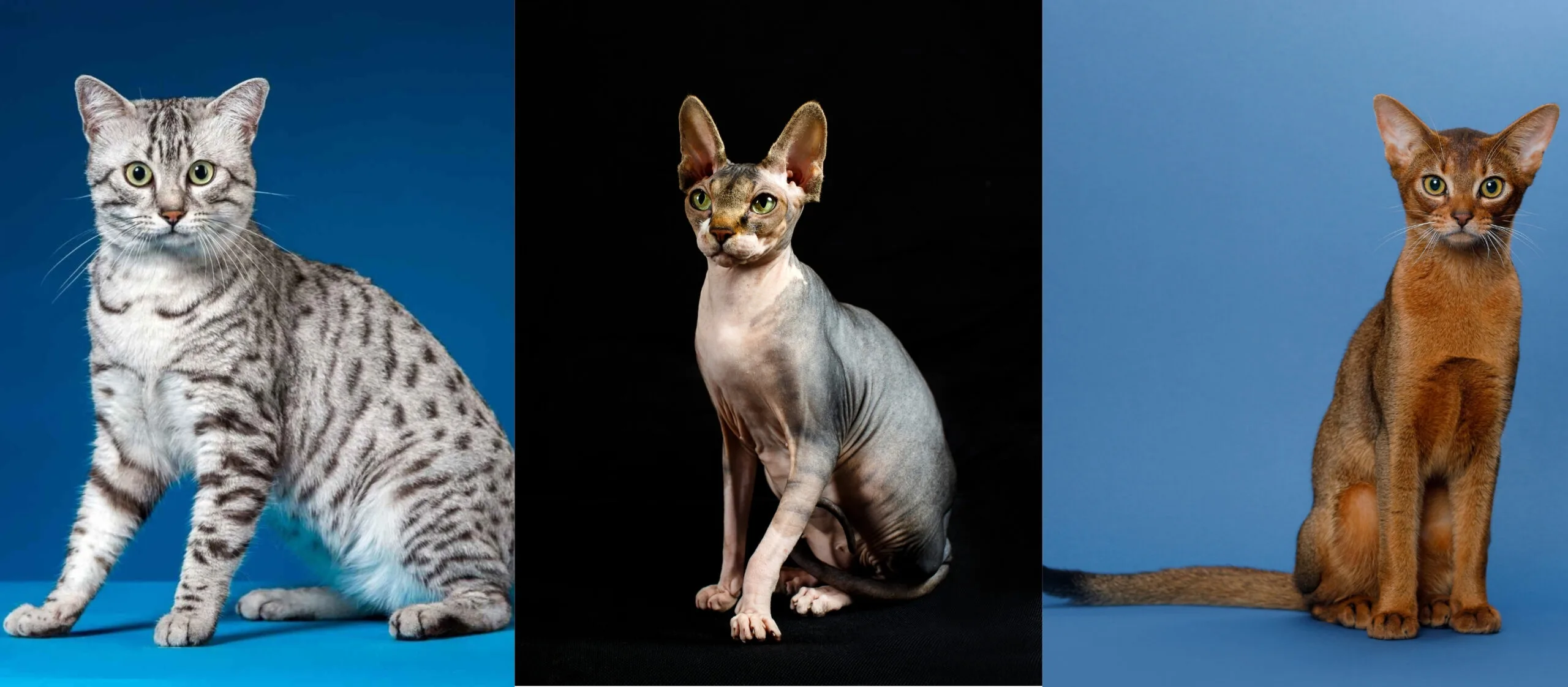
Three modern cat breeds carry the Egyptian legacy most directly or most visually. The Egyptian Mau is the most historically grounded, the only naturally spotted domestic cat, descended from cats brought from Cairo's streets to Europe and the United States in the 1950s by Princess Nathalie Troubetskoy, who had rescued them while living in Italy. The Mau's spotted coat and lean athletic build appear in ancient Egyptian art with striking consistency, and its name means "cat" in ancient Egyptian. If you are naming a cat in that tradition, the guide to Egyptian cat names gathers goddess, pharaoh, and modern Egyptian options with their meanings.
The Sphynx has Egyptian associations primarily through its striking visual resemblance to the Great Sphinx of Giza, but it originated in Toronto in 1966 from a natural hairless mutation. The connection is aesthetic rather than genealogical.
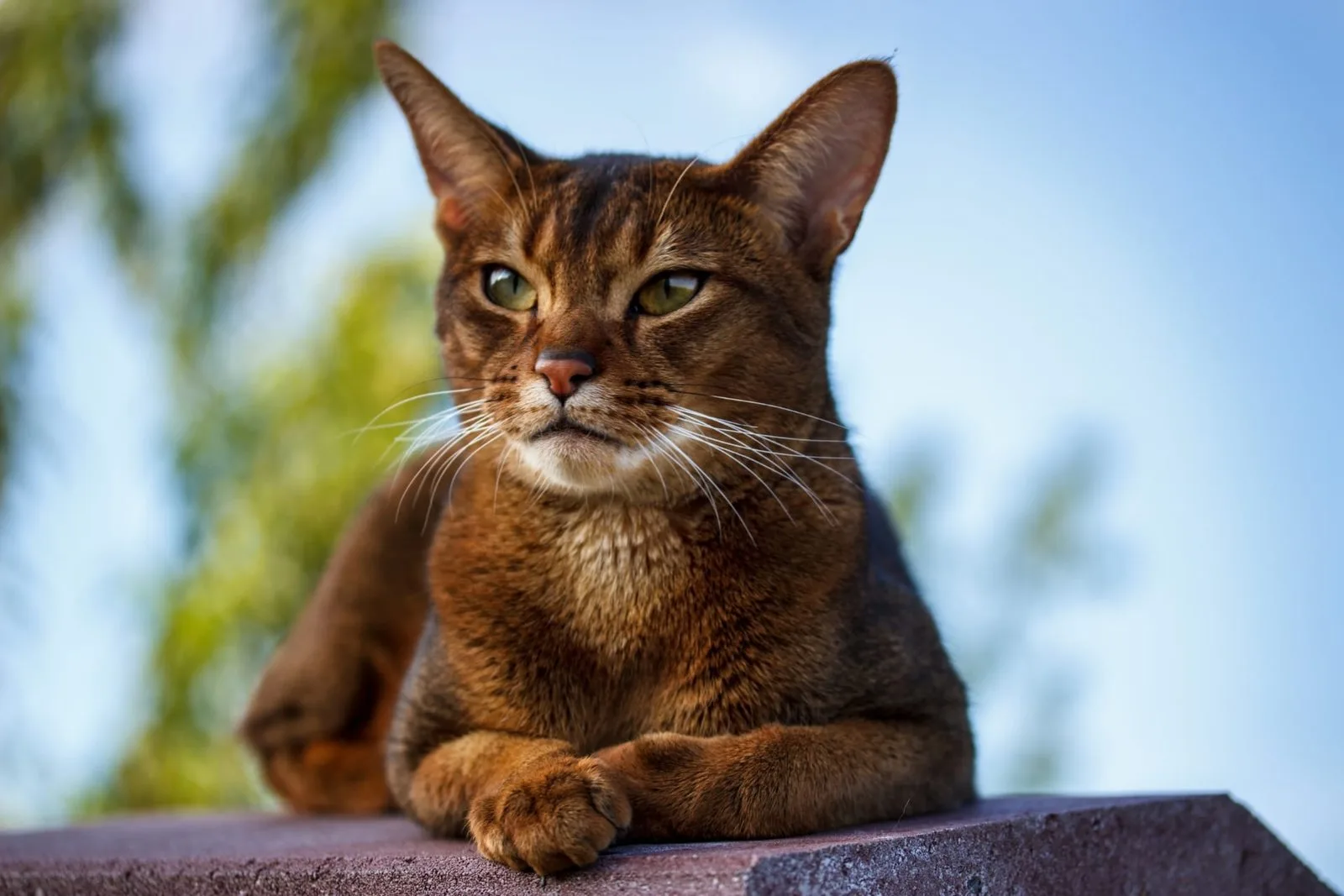
The Abyssinian has a more complicated relationship with Egypt. Its origins are debated: DNA evidence points toward South Asian ancestry, but Egyptian trading routes were likely part of its dispersal into Europe. Ancient Egyptian art repeatedly depicts cats with the Abyssinian's characteristic ticked coat and long-limbed build.
Caring for Egyptian-associated breeds
The Egyptian Mau and Abyssinian are active, intelligent breeds with higher stimulation needs than typical domestic cats. Both benefit from interactive daily play, vertical climbing space, and (particularly the Abyssinian) the company of another active cat if the owner works long hours. The Sphynx requires weekly bathing to manage skin oil accumulation and warmth management through the cold months, alongside monitoring for hypertrophic cardiomyopathy, a breed-specific cardiac condition.
All three are people-oriented animals. Daily interaction is not optional for these breeds: it is a welfare requirement. The cat care guide covers the broader ownership context. For anyone who travels and needs a cat sitter to cover these breeds, the specific energy levels and care requirements are worth communicating explicitly: a sitter who knows they're looking after an Abyssinian rather than a standard domestic shorthair will approach the engagement requirement differently. On Petme, sitter profiles show real experience with animals in their care, which matters more for these breeds than for less demanding cats.
Frequently asked questions
1. Why were cats sacred in ancient Egypt?
Egyptian reverence for cats built on a foundation of practical value: cats protected grain stores from rodents and killed snakes, which were genuine threats to both food supply and safety. This practical role evolved into religious significance. Cats became associated with the goddess Bastet and were incorporated into cosmic mythology, including the Book of the Dead, where a cat defeats the serpent of chaos Apophis. The combination of practical value and divine association produced a culture in which cats were genuinely revered rather than simply tolerated.
2. What is the cat goddess of ancient Egypt?
Bastet is the most important cat deity, depicted as a domestic cat or as a woman with a cat's head. Her earlier form was leonine, a warlike solar goddess, but by the New Kingdom she had become associated with fertility, motherhood, and household protection. Her cult center at Bubastis drew some of the largest religious festivals in ancient Egypt. Sekhmet, the lion-headed goddess of war and healing, is related to Bastet and was sometimes conflated with her in ancient texts.
3. Did ancient Egyptians really worship cats?
The more accurate framing is that they revered cats as sacred animals associated with divine qualities, rather than worshipping them as gods in their own right. Cats represented the qualities of Bastet and were treated accordingly, protected by law, mummified, honored in art and ritual. The distinction matters because it better explains the evidence: Egyptians did not pray to cats themselves, but they took feline lives very seriously and would mourn a cat's death in the same way they mourned human relatives.
4. What happened to cats after the decline of ancient Egypt?
As Egypt came under Greek, then Roman rule, the sacred status of cats diminished formally but their practical role and cultural presence continued. Roman soldiers and traders spread domestic cats throughout the Mediterranean and eventually into Europe, where they continued to fulfill their pest-control function. The domesticated lineages that originated in or passed through Egypt are the ancestors of the cats that eventually spread globally. The Egyptian Mau preserves the most direct genetic connection to this ancient population.
5. Did Cleopatra have cats?
No direct historical record confirms this, but the circumstantial case is strong. Cleopatra lived during the Ptolemaic period (69–30 BC), when cats remained culturally significant in Egypt, and her position as pharaoh would have made her a natural keeper of animals associated with Bastet. Given how thoroughly cats were woven into Egyptian aristocratic life, their absence from a royal household would have been notable. The absence of a specific record likely reflects the general loss of personal domestic detail in ancient sources rather than actual absence of cats.
6. What modern cat breed is most closely related to ancient Egyptian cats?
The Egyptian Mau has the most directly traceable lineage. Modern Maus descend from cats brought from Cairo's streets to Europe and the United States in the 1950s, and the breed's naturally spotted coat pattern (appearing spontaneously rather than through selective breeding) matches the spotted cats depicted in Egyptian artwork. DNA studies of Egyptian Maus confirm their North African genetic heritage. The Abyssinian's ticked coat and body type match ancient Egyptian depictions closely, though its full genealogy traces through multiple continental populations rather than directly from Egypt. 🐈⬛
Ancient Egypt's relationship with cats lasted more than three thousand years and produced one of the most detailed records of human-animal coexistence in any ancient culture. The animals depicted in tomb paintings, cast in bronze, and mummified by the thousands are the direct ancestors (genetic and cultural) of the cats people keep today. That continuity across millennia is part of what makes the story of Egyptian cats something more than historical curiosity.