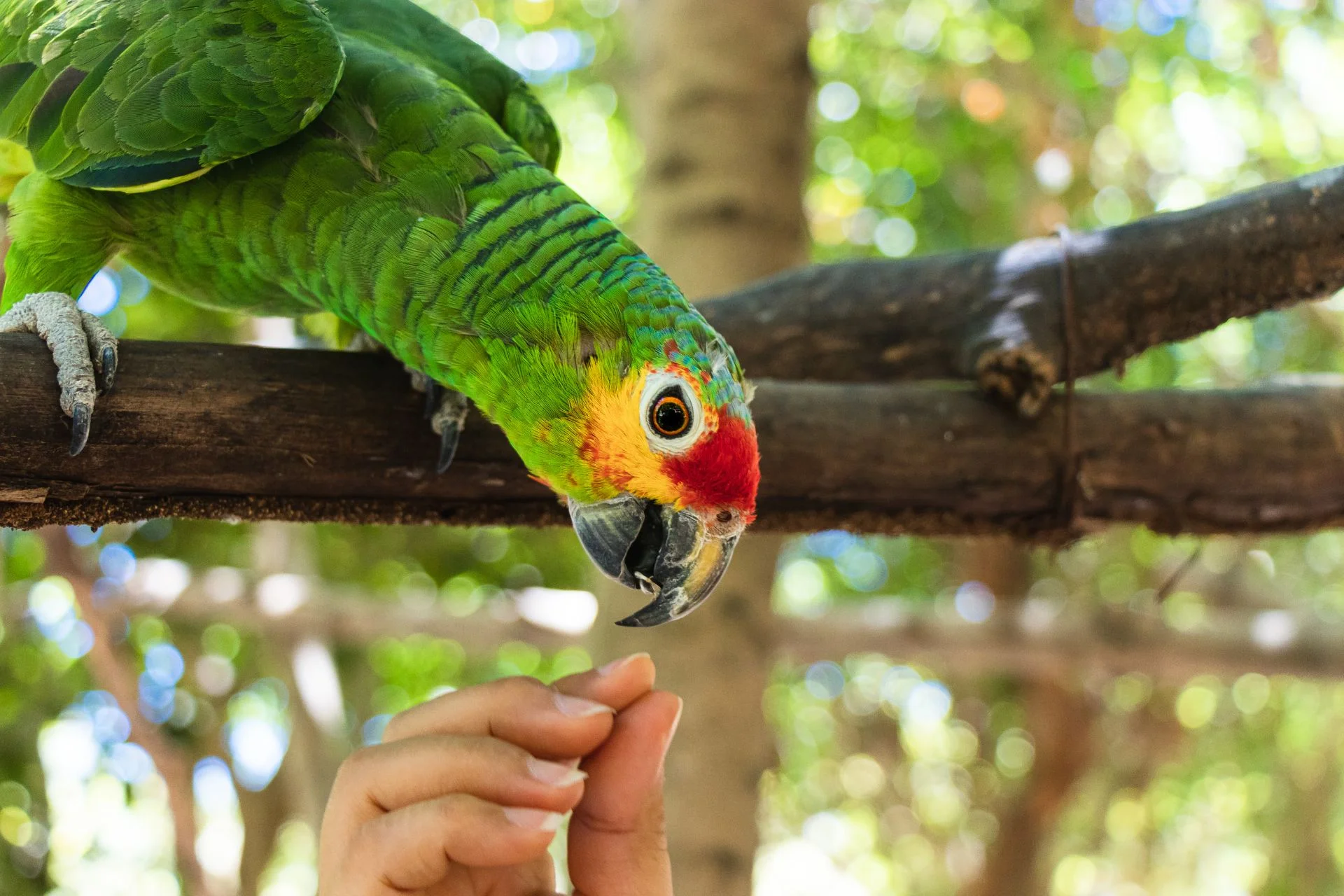
Parrots are intelligent birds with real learning capacity. They can be taught a wide range of behaviors, from basic handling commands to complex tricks and flight recall, using reward-based techniques. Understanding how positive reinforcement works and applying it consistently produces a bird that is easier and safer to handle, forms a stronger bond with its owner, and is generally better adjusted behaviorally.
Understanding parrot behavior
Before training begins, a basic understanding of how parrots learn is useful. Parrots are social animals that communicate through vocalizations, body language, and physical posture. They learn through observation, imitation, and the association of behaviors with outcomes. A behavior that is followed by something positive is more likely to be repeated. A behavior that produces no outcome, or an unpleasant one, decreases over time. Parrots are highly motivated by rewards. The key to effective training is identifying what your individual parrot values most, whether that is a specific food treat, access to a favorite toy, verbal praise, or physical affection, and using that consistently as a reinforcer.The principles of positive reinforcement
Positive reinforcement works by pairing a desired behavior with an immediate reward. Timing is the most important variable: the reward must come within one to two seconds of the behavior, or the bird may associate the reward with whatever it was doing at the moment of delivery rather than the target behavior. A clicker or verbal marker such as the word "yes" bridges the gap between behavior and treat delivery. Mark the behavior the instant it occurs, then deliver the reward. Over time the marker itself becomes a signal that a reward is coming, which maintains motivation even during complex behavior chains where delivery takes a moment. Rewards do not have to be food every time. Praise, attention, play, and access to preferred activities all function as reinforcers for parrots that value them. Varying the reward type keeps training sessions engaging and prevents the bird from becoming satiated on a single treat type.Getting started with training
Create a positive environment before beginning. Training works best when the parrot is calm, engaged, and slightly hungry, typically before a main meal rather than immediately after. Choose a quiet location free from distractions during initial sessions. Build trust first. If your parrot is new or wary of close interaction, spend time near the cage without attempting to train. Allow the bird to approach on its own terms. Offer a treat through the cage bars without any expectation or demand. This establishes that your presence is associated with good things before any formal requests begin. Keep sessions short. Five to ten minutes is sufficient for most parrots, particularly in the beginning. End each session while the bird is still engaged rather than waiting until it loses interest or becomes frustrated.Basic training techniques
Target training
Target training teaches a parrot to touch a designated object, typically a short stick or a pointer tip, with its beak. Hold the target near the bird and wait. When the bird investigates and touches it, mark and reward immediately. Gradually move the target to different positions to guide the parrot through simple movements. Target training forms the foundation for many other behaviors.Clicker training
A clicker is a small device that produces a distinct consistent click. The click is conditioned as a marker by pairing it repeatedly with a treat: click, then immediately deliver a treat, without asking for any behavior. Once the parrot clearly understands that a click predicts a treat, the clicker can be used to mark exact moments of desired behavior. Clicker training is particularly useful for precise timing with complex behaviors.Step-up training
Step-up is one of the most practical behaviors to establish early. Hold your arm or a perch horizontally near the parrot's lower body. Say "step up" in a calm, clear tone. When the bird steps onto the arm or perch, mark and reward. With repetition, the verbal cue becomes reliable. Step-up makes daily handling, cage transfers, and vet handling considerably safer and easier.Advanced training techniques
Teaching tricks and commands
Once basic commands are reliable, more complex behaviors can be built on them. Wave, retrieve, spin, and play dead are all achievable for most parrots with patient shaping. Break each trick into small achievable steps and reward each step consistently before combining them into the complete behavior.Harness training
A flight harness allows safe outdoor time for parrots. Introduce the harness gradually, associating it with rewards before any attempt to put it on. Begin by simply showing the harness and rewarding calm behavior. Progress to touching the bird with it, then working toward wearing it for short periods. The process can take weeks for a bird that is initially wary.Flight recall training
Flight recall trains a parrot to fly back to the owner when called. Start in a controlled indoor environment, calling the bird from a short distance and rewarding heavily when it returns. Gradually increase the distance. This behavior is potentially life-saving if a parrot escapes outdoors.Overcoming common challenges
Biting is a natural parrot behavior that can be managed through training. Rather than responding to a bite with a reaction that inadvertently reinforces attention-seeking behavior, focus on teaching incompatible behaviors. A parrot that is stepping up or targeting cannot simultaneously bite. Reward calm cooperative behavior and reduce the situations that trigger biting. Fear of specific objects or situations can be addressed through gradual desensitization. Expose the parrot to the feared stimulus at a distance or intensity that does not trigger a fear response, and pair that low-level exposure with rewards. Gradually increase the intensity as the parrot habituates to each level. Stubbornness or lack of engagement during training usually indicates that the reward is not motivating enough, the session is too long, or the behavior being asked is too difficult for the current stage of learning. Adjust one variable at a time rather than multiple things simultaneously.Training behaviors that help pet sitters
A well-trained parrot is a considerably safer and easier parrot for a sitter to manage. The behaviors most useful during a sitting assignment are:- Reliable step-up on request from an unfamiliar person, which allows the sitter to handle the bird for cage transfers and interaction without risking injury
- Return to cage on a verbal cue, which lets the sitter end out-of-cage time without chasing or stressing the bird
- Calm acceptance of close proximity without biting, which makes daily care less stressful for both parrot and sitter
- Comfort with hand-feeding of treats, which helps a sitter begin building their own positive association with the parrot
Frequently asked questions
1. Does positive reinforcement training work for all parrot species?
Yes, though the pace and style may vary by species and individual temperament. Highly social species like African Greys and macaws are generally highly responsive. More independent species may need shorter, less frequent sessions. Individual personality matters as much as species: some parrots are eager learners from the start while others require more trust-building before training sessions produce consistent results.
2. How long does it take to train a parrot?
It depends on the behavior, the parrot's age and prior experiences, and the consistency of training. A reliable step-up command can often be established within days to weeks of consistent short sessions. Complex tricks or fear-based behavioral rehabilitation can take months. There is no fixed timeline, and comparing your parrot's progress to others of the same species is less useful than tracking improvement from its own baseline.
3. Are there risks to positive reinforcement training?
The method itself carries minimal risk when conducted correctly. The main risk is inadvertently reinforcing unintended behaviors by rewarding at the wrong moment or by giving attention to screaming or biting. Timing and consistency are the most important skills to develop. If training sessions consistently produce stress responses in the bird, the pace or approach needs adjustment.
4. Can an older parrot learn new behaviors through positive reinforcement?
Yes. Parrots can learn at any age, though older birds with well-established habits may take longer to adjust than younger ones. An older parrot that has never been trained may initially be suspicious of training sessions. Starting with extremely low-stakes interactions, such as simply offering treats without any request, builds the foundation of trust needed before formal training becomes productive.
5. What should I do if my parrot does not respond to positive reinforcement?
First assess the reinforcer: the reward must be something the parrot genuinely values. Try different treats, toys, and types of attention to find what motivates your bird. Then assess session length and timing. Short sessions at the right time of day, before meals and when the bird is calm, produce better results than long sessions when the bird is already satisfied or tired. If progress remains minimal, consult an avian behaviorist who can observe the sessions and identify what needs to change.
6. How can training help when leaving my parrot with a sitter? 🐾
A parrot with a reliable step-up and return-to-cage command is much safer to manage for a sitter who does not yet have a personal bond with the bird. Show the sitter the exact cues you use and the rewards that work best. If your parrot has been trained to accept treats from new people, have the sitter offer a small treat on their first meeting to start building a positive association. The more trained and predictable the bird's behavior, the less the sitter needs to rely on instinct or guesswork during the sit.