In short: The six commands that pay off most are sit, stay, come, down, leave it, and heel. Start at 8 weeks, keep each session under 5 minutes, and reward every success with a treat. A dog that reliably responds to these six cues is safer in everyday situations and significantly easier for anyone else to handle when you're not around.
When to start
Training can begin the week you bring your puppy home, typically around 8 weeks old. Puppies at this age have short attention spans but are highly receptive to pattern learning. Short, frequent sessions work far better than one long one per day.
Five minutes, three times a day is a realistic starting point. When your puppy loses focus or starts sniffing the floor mid-command, the session is over. Ending on a success, even a small one, means the next session starts from a positive position.
The window between 8 and 16 weeks is the most receptive period for shaping behavior. Older dogs absolutely can learn new commands, but the earlier you build these foundations, the less work you'll need to undo later.
The 6 commands, step by step
Sit
Sit is the starting point for almost everything else. It's also one of the easiest commands to teach because the movement involved is natural.
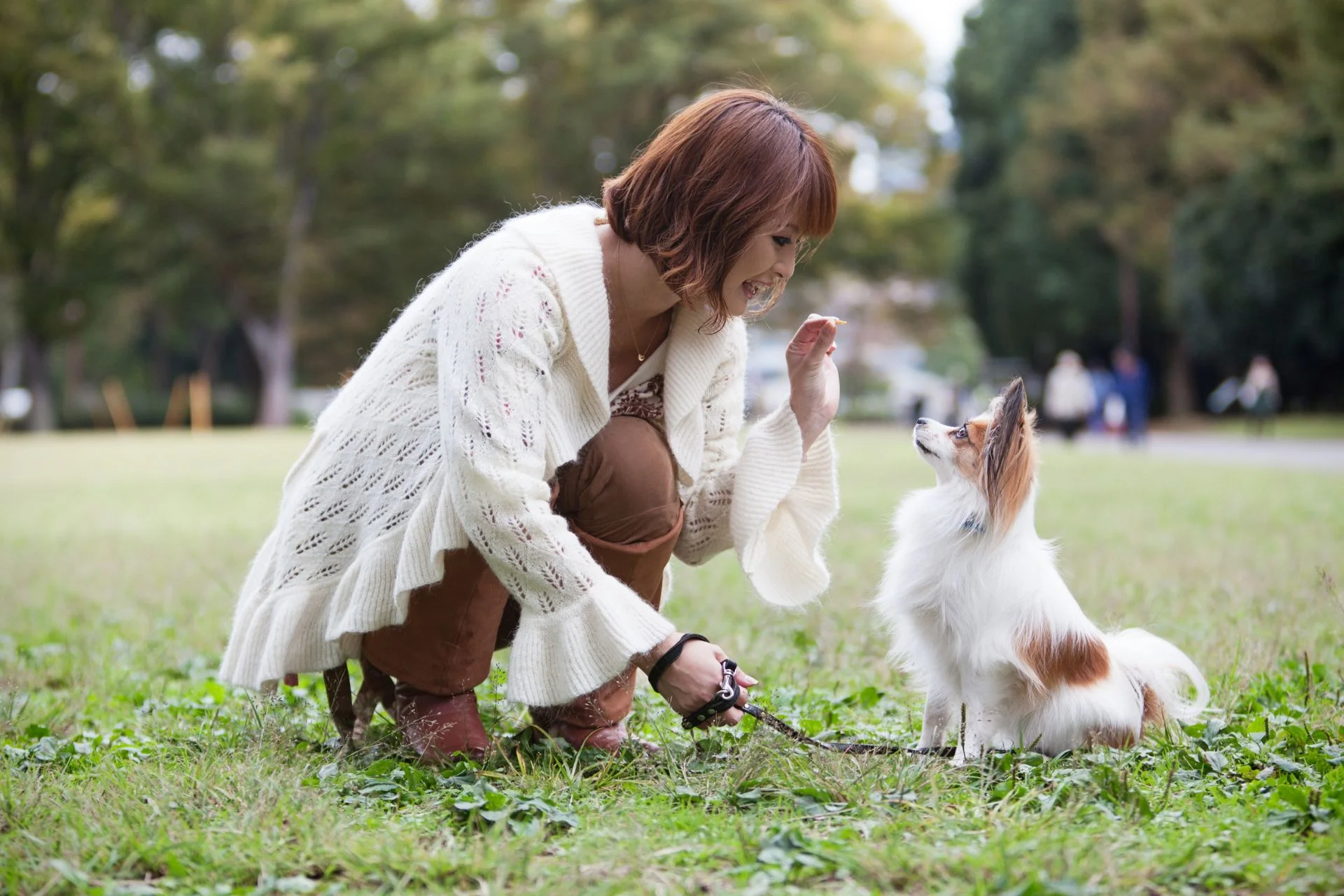
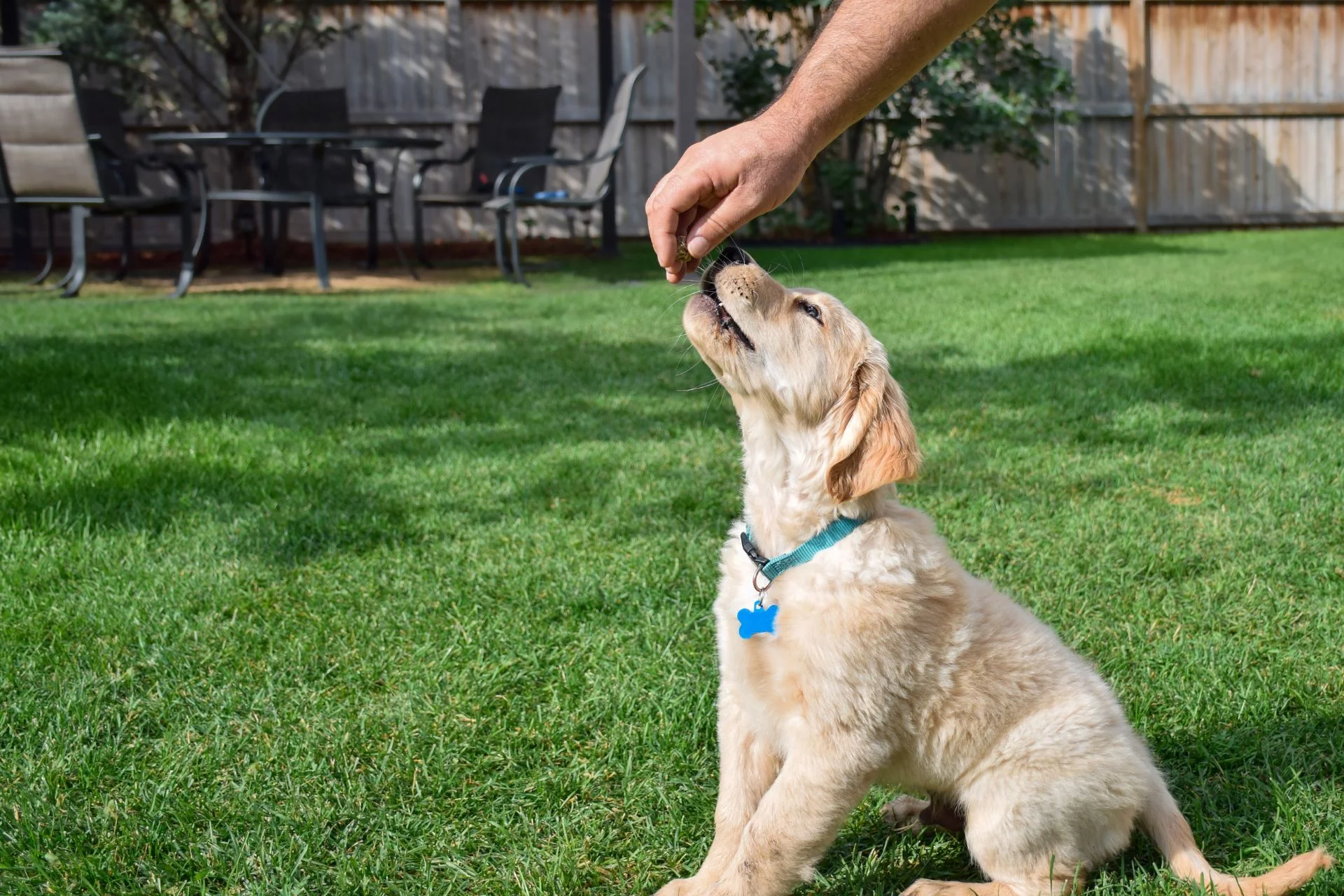
Hold a treat just above and behind your puppy's nose. As their head tilts back to follow it, their bottom naturally lowers toward the floor. The moment they're sitting, say "sit", reward, and release. Over several sessions, start saying the word a fraction of a second before they're fully down, so they begin associating the sound with the action rather than just the treat movement.
Stay
Stay builds self-control, which is the underlying skill behind most well-behaved dog behavior.
Ask your puppy to sit. Show your palm flat like a stop signal, say "stay", and take one step back. Return immediately, reward, and release with a consistent word like "OK" or "free". The release word matters, because stay means nothing without a clear end signal. Build duration before you build distance, and distance before you add distraction. One extra second or one extra step at a time.
Come
Come is arguably the most important safety command your dog will ever learn. A reliable recall can stop a dangerous situation before it develops.
Use an enthusiastic tone every time. Say your puppy's name, then "come". Crouch down, open your arms, make yourself the most interesting thing in the room. When they arrive, reward generously. Never call your puppy to come and then do something they dislike immediately afterward, like nail trimming or a bath. If "come" repeatedly predicts an unpleasant experience, they'll start hesitating before responding.
Down
Down positions your dog fully on the floor and requires more impulse control than sit, which is what makes it worth teaching separately.
Start from a sit. Hold a treat at your puppy's nose, then move it slowly straight down to the floor between their paws. As they follow it down, their elbows should contact the floor. Say "down" at that moment and reward. Some puppies pop back up immediately, which is fine. Reward the brief down and build duration the same way you did with stay.
Leave it
Leave it is the command that stops your dog from eating something hazardous on the pavement, approaching another dog aggressively, or fixating on something you need them to ignore.
Hold a treat in your closed fist. Let your puppy sniff, paw, and push at it. Wait. The moment they pull their nose away and look elsewhere, mark that with "leave it" and reward them from your other hand, not the one they were investigating. The reward always comes from a different source than the thing they left behind. Progress to the command with treats on the floor, then with real-world objects once the closed-fist version is solid.
Heel
Heel means your dog walks calmly beside you without pulling. It's what turns a walk from a physical contest into something both of you can enjoy.
Start with your puppy on your left. Take one step, reward them for staying beside you, stop. One step becomes two, two becomes five. If your puppy pulls ahead, stop walking entirely. No forward progress for pulling, because pulling that works even occasionally gets reinforced as a strategy. Consistency here matters more than technique.
Training principles that work
Positive reinforcement is the method with the strongest outcomes for puppies. Reward what you want to see more of. Ignore, redirect, or manage what you don't. Punishment-based methods, including harsh verbal corrections and physical pressure, introduce fear and anxiety that interfere directly with the learning process and erode the trust you're building.
Consistency across everyone in the household matters as much as anything else. If one person uses "down" to mean lie flat and another uses it to mean get off the sofa, and the tone shifts depending on mood, the command stops meaning anything clear. Same word, same hand signal, same expectation every time.
Keep rewards coming at a high rate early on. Treats, play, and genuine praise all count. Once a command is solid, you can phase treats out gradually, but fading rewards too quickly before a behavior is reliable is one of the most common reasons training stalls.
The full guide to training your dog covers more advanced commands and how to progress once these six are consistently reliable.
Socialization alongside training
Commands and socialization run in parallel during the first 16 weeks. A puppy that knows "sit" but has never encountered a pushchair, a bicycle bell, or a person wearing a hat will freeze or react when it meets those things, making any trained behavior temporarily irrelevant.
Socializing your puppy in this window means controlled, positive exposure to different sounds, surfaces, people, and environments. The goal isn't maximum novelty. It's breadth of calm familiarity, so your dog develops a working assumption that new things are manageable rather than threatening.
If you have a cat at home, the puppy-to-cat introduction is a separate process that rewards patience. A stressed or reactive cat makes training sessions harder for everyone. There's a dedicated guide to introducing a puppy to a cat that covers the timeline and the mechanics in detail.
Handing commands over to a dog walker or sitter
A trained dog is only as well-behaved as the people handling them stay consistent. When you leave your puppy with a sitter or dog walker, the commands they know become that person's primary toolkit for the day.
A sitter who doesn't know whether your dog uses "down" or "off", whether your recall word is "come" or "here", or that your puppy needs to sit before a treat gets handed over, is working without the context that makes training stick. Every interaction where a different word gets used, or where a sit gets skipped because it's easier, teaches your dog that the rules are negotiable.
Before any booking, write down the exact verbal cues and hand signals you use for each command. Note which ones are reliable, which are still in progress, and any dog-specific context a sitter should know: a puppy who freezes rather than returns when startled needs a different approach to recall than one who sprints back at full speed. Most sitters genuinely want this information. It makes their job easier and keeps your training consistent while you're away.
Petme sitters work with dogs at all training levels. If your puppy is still building these basics, booking shorter walks with a sitter who knows what to expect is a better outcome than hoping your dog performs reliably in an unfamiliar context with someone new.
FAQs
What are the 7 most important dog commands?
The six in this article (sit, stay, come, down, leave it, heel) plus "off" cover the essential baseline. "Off" teaches dogs not to jump on people, which matters for safety around children and visitors. These seven commands address impulse control, recall, leash manners, hazard avoidance, and the ability to stop an unsafe behavior mid-action. They're not the ceiling of what a dog can learn. They're the floor every other training builds on.
What are the first 5 commands to teach a puppy?
Start with sit, come, stay, down, and leave it, roughly in that order. Sit and come have the clearest safety payoff in the first weeks. Stay and down build on sit and develop impulse control. Leave it protects your puppy during the phase when everything on the floor looks worth eating. Heel and off can follow once these five have some consistency behind them in low-distraction environments.
What is the 10-10-10 rule for puppies?
The 10-10-10 rule is a socialization guideline: expose your puppy to at least 10 different people, 10 different environments, and 10 different experiences before the socialization window closes at around 16 weeks. The goal is breadth over depth. A puppy who has only encountered your flat and your immediate family has no frame of reference for anything else, and unfamiliar situations will trigger stress responses that training alone can't fix.
What is the 7 7 7 rule for dogs?
The 7-7-7 rule is a breeder's socialization checklist for the first seven weeks of a puppy's life. Before leaving the breeder, a well-prepared puppy should have experienced 7 different surfaces, 7 different locations, met 7 different people, heard 7 different sounds, been handled in 7 different ways, played with 7 different objects, and encountered 7 different challenges. It's a breeder responsibility checklist rather than one for new owners, but it explains why puppies from attentive breeders adjust to new homes more smoothly.
How long does it take for a puppy to learn basic commands?
Most puppies start responding reliably to sit, come, and down within 1 to 3 weeks of consistent daily training. Reliable means 8 or 9 correct responses out of 10 in a quiet, familiar environment. Adding real-world distraction, such as a park or a street with other dogs, takes considerably longer. Leave it and heel in unpredictable environments often need 2 to 3 months of consistent work before they're genuinely dependable outside the home.